

The FLEX-CHP project aims at quantifying the potential contribution of biomass- and waste-fired Combined Heat and Power (CHP) unit to the safety of supply and to the network balance in Belgium. We collaborate with two industrial partners: 2Valorise and Entras.
This project is funded by the Belgian federal Energy Transition Funds (FOD/SPF Economie).

The increasing share of renewable energy sources in Belgium poses a future challenge of balancing the inherent variability in power generation. FLEX-CHP is exploring the potential of CHP plants to address this. Utilizing local biomass and waste residues, these plants can provide flexibility services to the electricity grid. The project aims to decouple heat and power production in these units by integrating energy storage systems and advanced dispatch algorithms. The current cogeneration plants operate in a heat-following mode; the project explores technical options and employs Machine Learning techniques to transform them into network support for load balancing, addressing technical and economic uncertainties. The outcomes of this project are expected to optimize the efficiency of these units, demonstrating their potential role in supporting the grid's balance.
In close collaboration with our two industrial partners 2Valorise and Entras, we developed a Python framework to model the plant's operation and test flexibility measures for energy and ancillary service markets. Furthermore, flexibilization measures like thermal energy storage and batteries were integrated into the framework. These enhancements allow for a "power and heat following" mode, optimizing emissions, cost efficiency, and energy efficiency performance. The project showcased its progress at the "Het Vlaams Bio-Energieforum" conference in Drongen, providing a glimpse into the potential of flexible cogeneration plants in the evolving energy landscape.
Vlaams Bio-energieforum (3/10/23)
We recently presented our current results and the developed framework at the "Vlaams Bio-Energieforum" organised by ODE and biogas-e in Drongen, on Oct 3rd 2023. Our presentation is available here:
.
BERA bioenergy workshop (29/11/2024)
During the Belgian Energy Research Alliance (BERA) workshop about bioenergy, we presented our latest results of the FLEX-CHP project. In this presentation, we provided our estimated energy potential of biomass and waste for Belgium and the importance of incorporating flexible service in the current fleet of cogeneration plants. In addition, we presented the current progress of modelling, validating and simulating the performance of a representative cogeneration plant running on waste streams and our future work.
Report of the energy potential of waste- and woody-biomass in Belgium (14/02/2025)
Please read our latest report for a detailed analysis of Belgium’s future cogeneration energy potential from renewable and non-renewable, non-recyclable waste. It explores the key factors influencing waste-to-energy potential, the role of policy and waste management, and the implications for the Belgian cogeneration fleet by 2040. The report also highlights an energy supply gap of 6.6 TWh and discusses why municipal and renewable waste plants must adapt operations to future challenges. Read the report to learn more about the findings and scenarios.
The FLEX-CHP project concluded on October 31, 2025.
You can access the final deliverable here for a comprehensive summary of our findings and recommendations.
This study investigates how a waste-wood-fired CHP plant can be retrofitted and optimised to operate more flexibly and economically within modern, volatile energy markets. It provides a comprehensive techno-economic assessment, including design optimisation, uncertainty analysis, and market-scenario evaluation, while outlining the policy and research context needed to support future biomass cogeneration flexibility.
A report on the future contribution of biomass- and waste-fired CHPs to the security of supply and the stability of the electric grid in Belgium can be consulted via the link below.
Two scientific papers based on the project’s results will be submitted for publication in academic journals. They will be shared on this page as soon as they become available.
The first scientific paper has been submitted to the Journal Energy Conversion and Management and is currently undergoing peer review. The title of this paper is: 'How can a wood residue cogeneration plant provide flexibility to the grid? Techno-economic design optimisation of a combined heat and power plant and its global sensitivity analysis.'
The abstract of this paper is:
The integration of renewable energy sources into the electricity grid necessitates an increasing degree of flexibility from dispatchable power plants, which biomass-fuelled cogeneration plants could provide. While these cogeneration systems are technically capable of delivering such flexibility, their economic feasibility under uncertainty and the value of integrating storage solutions and grid services remain insufficiently explored. This study developed and optimised an end-of-life woody residue-fuelled cogeneration system (with a nominal power of 9.5 MWe) and 4.5 MWth to evaluate its economic and technical performance under various configurations, including thermal and battery energy storage.
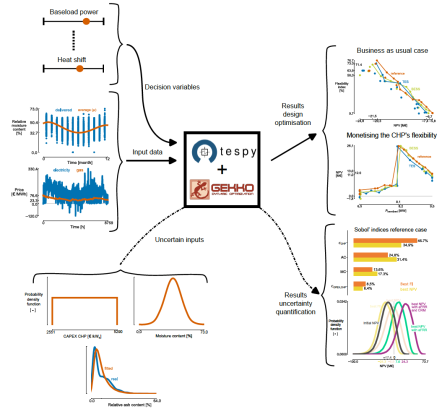
The work applies a multi-objective design optimisation and global sensitivity analysis to assess the trade-offs between net present value, flexibility and energy efficiency, while considering technical and economic uncertainties. All configurations that do not monetise their flexibility resulted in negative net present values under current market conditions due to low biomass quality and high costs. However, the inclusion of ancillary services and participation in the capacity remuneration mechanism significantly improved this economic performance. In combination with automatic frequency restoration reserve and capacity remuneration mechanism, a net present value of 26.1 Meuro at a baseload of 8.1 MW can be achieved. The cogeneration’s investment cost uncertainty was the most dominant factor (between 50% and 35%), followed by biomass ash (between 31% and 23%) and moisture (between 17% and 13%) content.
Future work should explore the retrofit potential of existing cogeneration systems for flexible services and incorporate the uncertainties linked to this retrofit and the outcome of the yearly capacity remuneration mechanism auction.
A graphical abstract of this paper is shown below.
The second scientific paper is currently being finalised. It will report on the two-step optimization approach used to analyze the impact of uncertainties on the economics of retrofitted CHP plants and will be submitted to the journal Waste and Biomass Valorization.
Once available, a link to both scientific papers will remain available on this webpage.